

Fostering an understanding of Deaf people as a linguistic and cultural minority is one of the most important things we do.
Our program is designed to aid students in acquiring proficiency in American Sign Language by applying their linguistic and cultural skills and knowledge to an academic area of study. From this foundation, students are prepared to engage in any number of professional fields related to deafness, including certified sign language interpreting.
ASL fulfills second language requirements at the University of Arizona.
The College of Education Department of Disability and Psychoeducational Studies offers courses in American Sign Language available for self-enrollment on a first-come, first-served basis. Please review the information below for details.
ASL course offerings
- SERP 370A (4 units): American Sign Language I
- SERP 370B (4 units): American Sign Language II
- SERP 431A (4 units): American Sign Language III
- SERP 431B (4 units): American Sign Language IV
All courses are typically offered in fall and spring (in person) and summer (online). Courses are only available for self-enrollment as seats are available on a first-come, first-served basis. Individual requests for enrollment will not be honored. Students may self-enroll onto the waitlist of full sections.
Have questions about the ASL Waitlist?
Visit the ASL Waitlist FAQ page to learn more.
Placement Information
As a general rule, students will not be placed above ASL 1 without documented college-level ASL credit from an accredited institution that has been officially evaluated and approved as equivalent.
Exceptions
Placement beyond ASL 1 may be considered under the following circumstances:
- College Transfer Credit
Students with completed college-level ASL coursework may be placed according to official transcript review and course equivalency evaluation. - High School ASL (Limited Eligibility)
Students who have completed three years of high school ASL under the instruction of a qualified ASL educator and take the placement assessment within one year of finishing those courses may be considered for placement up to ASL 2. Coursework must have included sustained interactive instruction and direct evaluation of expressive and receptive ASL skills. Placement decisions will be based on demonstrated proficiency through the official ASL placement evaluation. Completion of high school coursework does not guarantee advanced placement. - Heritage or Extensive ASL Background
Students who demonstrate substantial prior ASL use, such as native or heritage signers, individuals with immediate Deaf family members, or those with long-term immersion in ASL environments, may be evaluated for placement up to ASL 3. Placement into ASL 4 will not be permitted under any circumstance. - Deaf Studies Majors
Students who have declared Deaf Studies as their primary major may be reviewed individually in consultation with program leadership. - Demonstrated Mastery and Course Waiver
In rare cases, a student may demonstrate advanced, near-native, or master-level proficiency in ASL that clearly exceeds the learning outcomes of the four-course sequence. In such cases, the student may be considered for a full waiver of the ASL sequence (ASL 1–4), pending formal evaluation and program approval.
Retesting
The placement exam may be taken once within a 12-month period. Retesting to advance more quickly through the language requirement will not be allowed.
These policies are intended to preserve the academic integrity of the ASL sequence, ensure appropriate placement, and support long-term student success.
Contact Information
ASL Placement Request
Students seeking placement above ASL 1 without transferable college credit must submit a placement request.
Starting in ASL 1? Just enroll—no form needed.

Alex Lynch
Program Director
Programs We Offer
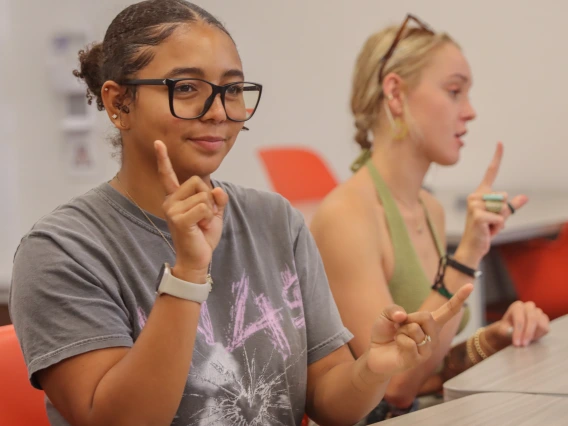
Deaf Studies, B.S.E.
Unlock a world of opportunities with our Bachelor of Science in Education (BSE) in Deaf Studies. This program immerses you in the rich culture and language of the Deaf community, equipping you with the skills to advocate, communicate, and educate effectively. Join a vibrant community of learners and prepare for a rewarding career making a difference in the lives of Deaf individuals.
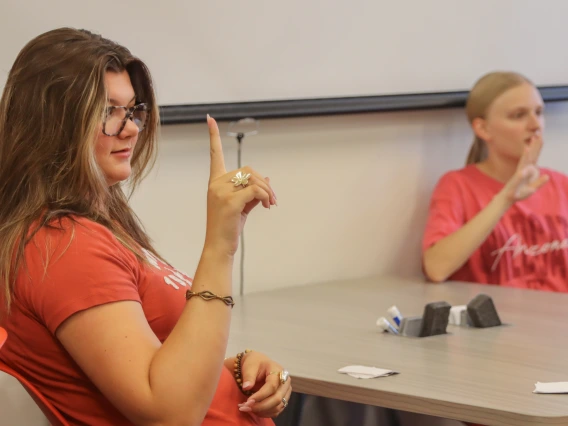
Deaf Studies, B.S.E. with Emphasis in Educational Interpreting
A shortage of interpreters for deaf and hard-of-hearing individuals exists in Arizona and the U.S. The shortage affects elementary and secondary schools most severely. The Educational Interpreting/ASL Interpreting emphasis is designed to address this problem. Stipends are offered for eligible students interested in pursuing interpreting careers in public K-12 schools after graduation. Explore this opportunity to make an impact in education.
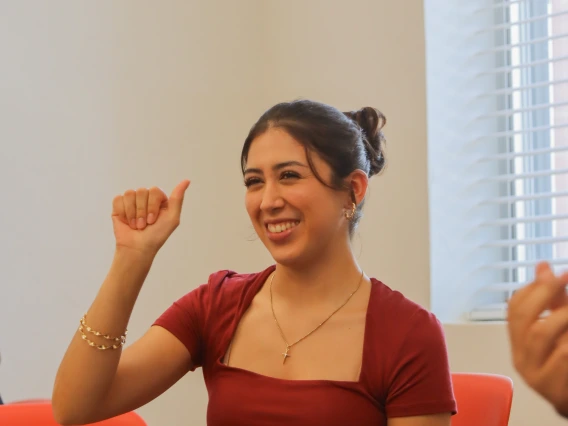
American Sign Language, Minor
Enhance your communication skills and cultural awareness with our American Sign Language (ASL) Minor. This program provides comprehensive ASL instruction and insight into Deaf culture, preparing you to engage meaningfully with the Deaf community. Add valuable language proficiency to your skill set and open doors to diverse career opportunities.
STUDENT ALUMNA
"What motivated me most was finally finding the degree program that I loved. The interpreting emphasis inspired me to give my all and motivated me to work as hard as I could to be the best interpreter I can be." ~Megan M.